



A seemingly simple question – “What tax rate applies to my company?” – rarely has a straightforward answer. The honest response would be: “Before I can tell you, I need to get to know your company a little better.”
Before determining the corporate tax rate: three essential questions
I. Business Activity or Asset-Holding Entity?
Article 5 of the Corporate Income Tax Act (LIS) defines an economic activity as the organization, on one’s own account, of production factors and human resources with the aim of participating in the production or distribution of goods or services. For property leasing, the law additionally requires at least one full-time employee under a labor contract. An entity is classified as an asset-holding entity (“entidad patrimonial”) when more than half of its assets consist of securities or of assets not used in an economic activity.
Securities are excluded from this calculation if they represent at least 5% of an entity’s capital, are held with the intention of maintaining that stake for at least one year and are managed using the entity’s own material and human resources.
Classifying an entity as asset-holding automatically rules out the reduced rates for microenterprises, small and medium-sized enterprises (ERD), and newly created companies — regardless of how low its net turnover may be.
II. What is the net turnover (INCN) at group level?
The LIS does not itself define Net Turnover Amount (INCN). One must instead refer to commercial accounting regulations — specifically Standard 11 on the Preparation of Annual Accounts under the General Accounting Plan, and rulings from the Spanish Accounting and Audit Institute (ICAC) — which exclude self-consumption, subsidies not tied to sale price, financial income, and indirect taxes such as VAT or excise duties from the calculation.
The critical point lies in Article 101.3 LIS: when an entity belongs to a group within the meaning of Article 42 of the Commercial Code, the INCN refers to the combined turnover of all group entities — net of intra-group eliminations and adjustments — regardless of tax residency, and even if there is no obligation to prepare consolidated accounts or file as a tax group. The same rule applies to “de facto” groups formed by an individual together with a spouse and relatives up to the second degree of consanguinity or affinity.
III. Is It Really a Newly Created Company or an Emerging Company (“Startup”)?
Simply having been recently incorporated is not enough to qualify for this regime. Article 29.1 LIS rules out the 15% rate in three situations:
- Continuation of a related party’s activity: companies that continue an activity previously carried out by related persons or entities within the meaning of Article 18 LIS, however the transfer was legally structured.
- Continuation of a shareholder’s activity: companies whose activity had already been carried out, during the year prior to incorporation, by an individual holding a direct or indirect stake of more than 50% in the new entity.
- Membership in a commercial group: companies forming part of a group under Article 42 of the Commercial Code, regardless of residency or any obligation to consolidate.
A startup, in the everyday sense, is not the same thing as a legally recognized “emerging company.”
Law 28/2022 establishes a separate regime from that for newly created companies. To qualify for the 15% rate in the first tax year with a positive taxable base and the following three years, a company must meet the requirements set out in Article 3 of that law — an innovative project, a scalable business model, no more than five years since incorporation (seven for biotechnology, energy, industrial, or other strategic sectors), registered office or tax domicile in Spain, at least 60% of its workforce based in Spanish territory, no listing on a regulated market, no prior dividend distributions, and no origin in a merger, spin-off, or conversion of a non-emerging company — and must also obtain a favorable evaluation from ENISA (the Spanish National Innovation Company), followed by registration with the Commercial Registry.
Without that formal accreditation, the emerging-company regime cannot be applied, no matter how well the company otherwise fits the profile.
The timeline at a glance
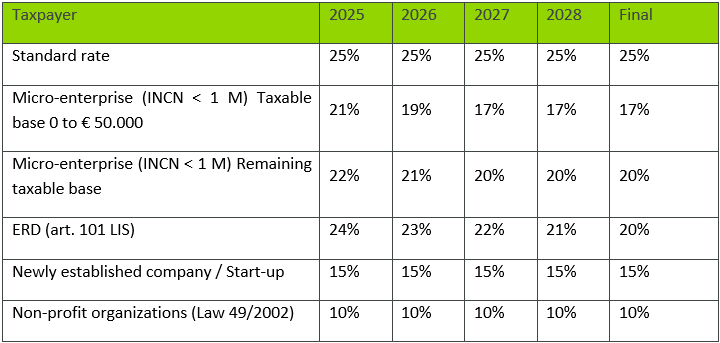
Two Angles That Often Get Overlooked: Minimum Taxation and the ERD Extension
Alongside the standard timeline, the LIS maintains a minimum taxation rule — Article 30 bis LIS — designed to prevent certain entities from paying below a statutory floor, even after applying deductions and tax credits. This applies to companies whose INCN over the twelve months prior to the start of the tax period is €20 million or more, as well as to all entities taxed under the tax consolidation regime, regardless of turnover. The minimum net tax liability is set at 15% of the taxable base, after applying the capitalization and equalization reserves and offsetting any negative taxable bases.
Conversely, a common point of friction is the extension of ERD status once the €10 million INCN threshold is exceeded. Article 101.4 LIS allows a company to retain ERD incentives — including the reduced rate — for the three tax periods immediately following the year in which that threshold is exceeded, provided the entity met the ERD requirements both in that year and in the two preceding years. In practice, this three-year extension can be the difference between a 24% and a 25% tax rate, and it is often overlooked in poorly planned year-end closings.
Common mistakes to avoid
- Applying the 21%/22% microenterprise scale without checking the INCN at group level.
- Classifying companies as “newly created” when they belong to a commercial group or continue the activity of an individual shareholder.
- Confusing microenterprise status with ERD status.
- Treating a startup as an “emerging company” without ENISA certification.
- Overlooking asset-holding classification in unstructured real estate companies.
- Applying deductions without checking the minimum taxation cap.
- Conclusion
Determining the applicable corporate tax rate is no longer a mechanical exercise. Every year-end closing requires reviewing three key issues: the nature of the company’s activity, the INCN at group level, and the possible application of special regimes for newly created or emerging companies. The coexistence of different rate scales, combined with a transitional timeline running through 2029, expands planning opportunities — but also increases the risk of tax adjustments down the line.
The practical recommendation is simple: build a specific analysis of the applicable rate into every year-end closing, explicitly documenting the entity’s classification, the composition of the commercial group for purposes of Article 42 of the Commercial Code, and — where applicable — ENISA certification or the ERD extension under Article 101.4 LIS.
Author:
Sergi Rovira
Partner, Tax Department, addwill